Showing posts with label #offthewineroad. Show all posts

Wednesday, March 30, 2022

Dreaming of Santorini's Assyrtiko and more

I am off to Santorini late May. Santorini, regarded as the most famous of all Greek islands, is also one of the top tourist destinations in the world. The amazing caldera formed by the volcanic eruption centuries ago, resulted in the most stunning sea views a human eye can ever see. Its fertile volcanic land produces products with distinctive flavors. Of course wine is at the top of this list. Santorini is renowned for its tradition in wine making and fine wine varieties. When my friend and I land in Santorini its boutique wineries are a must. Right at the top of my list will be checking Assyrtiko (A seer' tec ko) wines. Yep, you guessed it I am big on Assyrtiko.

Assyrtiko Vines, Santorini © Spaswinefood

Why Assyrtiko?

When Cinque Wine Bar, Athens hosted a virtual wine tasting March 2021 our conversations focused on Assyrtiko  wines from Domain Hatzimichalis, Gaia Wines, and Avantis Estate. These conversations transported me immediately to Greece. Assyrtiko, a white grape indigenous to Santorini, is arguably Greece's most iconic white wine grape variety. It is a wine with great diversity. Grown in the arid volcanic-ash-rich soil of Santorini and other Aegean islands, it is also found in other regions of Greece, planted as far north as Drama in Greek Macedonia. It is a versatile grape variety, with wines being made in a multitude of styles, from fresh, mineral driven white wines to rich, nutty dessert wines known as Vinsanto.  For sure  Assyrtiko is a great for conversations.

Assyrtiko Conversations, March 2021 © Spaswinefood 

Our Assyrtiko Virtual Wine Tasting centered around three wines: Domain Hatzimichalis, Gaia Wines, and Avantis Estate. 

1. Domaine Hatzimichalis, Assyrtiko Alepotrypa 2019
Domaine Hatzimichalis is a family owned winery located in Atlantis, Greece. The Assyrtiko wine from Hatzimichalis winery was introduced by Leonidas Hatzimichalis. Earlier during a Greek Wine tasting at home it was one of the four wines from Domaine Hatzimichalis that I tasted. To supplement the wine tasting Cinque provided online and other information for me to access. Domaine Hatzimichalis winery has been at the top of my must visit list for awhile; so I welcomed the opportunity to re visit this wine:
Domaine Hatzimichalis, Assyrtiko Alepotrypa 2019 © Spaswinefood
This Domaine Hatzimichalis Assyrtiko comes from a selected single vineyard Alepotrypa, which is part of the privately owned Domaine Hatzimichalis vineyards in the heart of the Atalanti Valley. 

Earlier in Greece I was introduced to Assyrtiko Alepotrypa 2016.

Domaine Hatzimichalis, Assyrtiko Alepotrypa 2016 © Spaswinefood

These are obviously two different vintages. I was impressed by both of these vintages, and I only wish my note taking allowed me to make comparisons.

 Domaine Hatzimichalis https://www.facebook.com/domaine.hatzimichalis/

2. Gaia, Assyrtiko Wild Ferment 2019
The second wine from Gaia Winery was introduced by Giannis Paraskevopoulos, Co-owner, Oenologist and Professor in the University of Oenologie, Athens. I look forward to tasting this wine.


3. Avantis Santorini Winery Assytiko Afoura 2018 
The third wine was introduced by Kotseridis George, Oenologist, Professor of Oenologie, University of Agriculture, Athens, consultant to Anhydrous Avantis Santorini Winery.  I look forward to tasting this wine.


While it was unfortunately I did not receive the shipment, which included the last two wines, both of which are from Santorini. Keith Edwards's article provides an excellent analysis of the three wines that includes these two wines. Given that I was looking forward to tasting them in the future I am excited to be off to Santorini this coming May.

Santorini Assyrtiko & More

One of the amazing discoveries for me during our session was, there are ancient Assyrtiko vines on Sanitorini. For sure Santorini Assyrtiko vines are amongst the most interesting. On the average these vines can reach 70 years old, and some of the wines are amongst the oldest in Greece. Growers have adapted to the growing conditions on the island by training their vines into "baskets", winding the canes into wall around the fruit, providing shelter from strong winds. Since advanced vine age tends to effect wine quality because yields are reduced, enhancing Assyrtiko's potential to make some very complex wines.


Discussing Santorini Assyrtiko Vines © Spaswinefood


Santorini Assyrtiko Vines Before Blooming © Spaswinefood

What stuck with me was that the Assyrtiko vines on Santorini are some of the oldest vines in Greece. The lack of water in the soil means the growers need to space the vines further apart than is usual. Moreover, the adaptation of the vines has resulted in the primary root(s) reaching around 5 meters, with the secondary roots being close to the surface to absorb humidity in the air. 

Santorini Volcanic Soil © Spaswinefood

For sure the Santorini terroir presents some challenges that significantly affect wine growing. The island is dry enough to be classified as a desert on the Köppen climate scale, and also very windy. On the plus side, the harsh volcanic soils of the island's vineyards have prevented the spread of phylloxera. Unlike most of Europe, the vines do not need to be grafted onto phylloxera-resistant rootstocks. 


Some of Santorini's wineries have tried special projects, like aging the wines under sea water. This is believe to have an interesting effect on the wines. Giannis Paraskevopoulos speculates it is not the effect of pressure that achieves this but the lack of oxygen. He suggests that this same experiment could be tried on land where wine bottles are immersed under water.  For sure Assyrtiko is very susceptible to oxidation. Santorini winemakers take advantage of this in the making of sweet Vinsanto wines. By controlling the level of oxidation, producers can create darker wines with fig, coffee, kirsch and chocolate characteristics. The grape's versatility, however, is that it can also be made into a dry wine, yellow-gold in color with mineral, pear, apple and citrus blossom aromas and flavors. Some versions are fermented in barrel. Naturally high acidity means that Assyrtiko wines can age for many years. Assyrtiko is sometimes blended with the Athiri and Aidani grape varieties on its native Santorini, in both dry and sweet styles. They are usually minor components of the blend. Assyrtiko, occasionally seen in Retsina, appears to be falling from favor for that purpose, as more varietal Assyrtiko wines are being crafted.


Assyritko's unique characteristics has also made it appealing to other countries around the world. One of those characteristics is drought resistant. One of the best examples of its ability to adapt is that Jim Barry Wines produced Australia's first Assyrtiko from 3 hectares (7.5 acres) of basket-trained vines in the Lodge Hill Vineyard in the Clare Valley. The vines were propagated from cuttings from Sanitorini's Argyros Estate. When Spaswinefood visited the Clare Valley in 2015 it was indeed a treat to taste at Jim Barry Wines. We did not taste Assyritko during this visit given it was first released in 2016 (see Decanter article).

Jim Barry Wines, Clare Valley, Australia © Spaswinefood


For sure the Assyrtiko session peeked my interest in knowing more about this wine. Especially after tasting these 2016 wines during a 2018 visit to Cinque.


1. Kokotos Estate, Perdika sto Ampeli 
2. Domaine Porto Carras Assyrtiko
3. Tsantali, Klimaklima Organic Assyrtiko 
4. Artemis Karamolegos, Assyrtiko

5. Pyritis, Santorini Mega Cuvée 

Kokotos Estate, Perdika sto Ampeli 2016 © Spaswinefood


Domaine Porto Carras, Assyrtiko 2016 © Spaswinefood

Tsantali, Klimaklima Organic Assyrtiko 2016 © Spaswinefood

Pyritis, Santorini Mega Cuvée 2016 © Spaswinefood


Let the Assyrtiko Conversations Continue 

I felt so fortunate that I am able to enjoy Greek Wines offered by Cinque. Since my first meeting with Evangelie and Greg in 2016, at Cinque Wine Bar, Athens I have had the pleasure to meet up with them and Nikitas at a number of #winelover hangouts in Europe. Of course, whenever I was able to return to Cinque it was always a special treat. For me getting to know Greek wines is an amazing journey. 

Cinque THANK YOU  

For sure I can not wait to visit Santorini's wineries. Yes, indeed Cinque in Athens will be my first stop before heading onto Santorini. I invite you to join me in my travels in Greece and elsewhere in the sharing of these adventures at Wine Travels with Dr. Sharon and at Spaswinefood on  Twitter and Facebook. 

 #ILoveGreekWines 
#SeeYouInGreece

Sharon
March 2022
Dreaming of Greece
© Spaswinefood
Evangelie and Greg, Cinque, Athens © Spaswinefood


 Nikitas, Madeira 2019 © Spaswinefood

Tasting Assyrtiko Wines, Cinque, Athens © Spaswinefood

Cinque, Athens is a #Winelover's Gem
Little did I know that a #winelover gathering in Athens in 2016 would connect me with a Facebook friend who owned a wine bar in Central Athens. Yes, the wine bar was Cinque. Some places are special because of the people. For Cinque it is not, just because they are nice, but also because they are knowledgeable about the wines and bring a special passion to serving wine at their wine bar. What I encountered on that initial #winelover outing (Valentine’s Day, February 14, 2016) at the Cinque was not only great wines and food, but also amazing hospitality from the owners who are both knowledgeable and passionate about Greek wines. There is a special #winelover magic in the air at Cinque Athens.  If you can not go to Cinque where there is a special #winelover magic in the air then consider one of their virtual experiences. Special thanks to Evangelie, Greg and Nikitas for sharing their passion for Greek Wines.  

Follow me on Twitter and Facebook

Wednesday, March 2, 2022

Explore Bordeaux wines, even old Bordeaux style wines pass their prime

I have enjoyed exploring Bordeaux wines over the years; so when a wine lover friend gave us some old Bordeaux style wines I was delighted. Before sharing the outcome of opening a few bottles of old red Bordeaux styles wines let me briefly review Bordeaux wines. After all you might ask, "what is special about Bordeaux red wines?" While perhaps there are many possible answers there are two points, which I would like to make. First, the aging potential, and second the price. The tannins are often high enough in Bordeaux red wines that these will age for decades. Yes, I know some Bordeaux wines can be quite expensive but overall, they are amongst the best buys. Often you can pickup good red Bordeaux wines in the 40-50 dollar range, and some in the 20's.

La Dame de Montrose, Chateau Bellegrave,  Chateau Lalande-Borie © Spaswinefood

Bordeaux Wines © Spaswinefood

Bordeaux Wines

First, I must admit Bordeaux wines present a challenge for some of us to make sense. Let me recall a sharing of wines from one of the most important Bordeaux regions, the Left Bank. This is an area where Cabernet Sauvignon wines dominate. The Left Bank Bordeaux Blend by law includes Cabinet Sauvignon, Merlot, Cabernet Franc, Petit Verdot, and Carmemere (rarely). The general flavor profile is black cherry, black current, cedar, cinnamon, baking spices, and graphite. Whereas, the general taste profile is dry, full body, medium-high tannins, medium acidity, with 13.5-15% ABV.

Photo of The Wine Districts of Bordeaux

It was an event where we were walked through the tasting of each wine by Claire "Sudsy" Torbeck  who drew from her extensive enological background. That event included five 2016 Bordeaux red wine blends from the Left Bank, from St-Estephe, Pauillac, St-Julien, and Margaux within Haut-Medoc area, and Pesac-Leognan within the Graves area.

La Dame de Montrose, Saint Estephe; Bellegrave, Pauillac; Lalande-Borie St-Julien © Spaswinefood

It was indeed a special treat when Claire introduced us to 2016 Bordeaux wines. We did not explore any wines from the Right Bank, or Entre-Deux-Mers areas. Neither did we explore white wines, or any of the recent rosé wines from Bordeaux. Obviously, there is so much to learn about Bordeaux wines. 

Claire "Sudsy" Torbeck © Spaswinefood

So if you are thinking about picking up some Bordeaux red wines to store then 2016 would be a good vintage to do so. Yes, you can store them until 2023 and beyond.

Checking the Wines © Spaswinefood
Bordeaux Wine Classification 1855 was done by wine brokers who ranked Chateaus based on reputation and price. Based on that system Chateaus were ranked from first through to fifth growths (crus in French). Needless to say, many Chateaus were not included in the original system. Ranking creates a bias given the perception of quality influences price. Nevertheless, these days do not be surprised if second growth ranking is getting a higher price than a first growth. 

To keep this discussion brief when we consider Bordeaux wines the following is an overview:

1. Bordeaux Red Wines

Left Bank Bordeaux Blend by law includes Cabernet Sauvignon, Merlot, Cabernet Franc, Petit Verdot, and Carmémere (rarely).


Right Bank Bordeaux Blend includes Merlot, Cabernet Franc, Cabernet Sauvignon.


Blind Tasting of Bordeaux and Bordeaux Style Wines © Spaswinefood


2. Bordeaux White Wines

A tiny part of Bordeaux’s wine production is dedicated to white wines. These wines are made with Sauvignon Blanc, Sémillon, and the rare Muscadelle.

2016 Bordeaux Reds and Sauternes Ready to Cellar © Spaswinefood


3. Sauternes and the Sweet Side of Bordeaux

Sauternes, a sweet wine from the Sauternais region of Graves. It is made from Sémillon, Sauvignon blanc, and Muscadelle grapes that have been affected by Botrytis cinerea (noble rot). Sauternes is one of the few wine regions where infection with noble rot is a frequent occurrence. Even so, production can be a hit-or-miss proposition, the harvests results vary from vintage to vintage. Wines from Sauternes, especially the Premier Cru Supérieur can be very expensive, largely due to the very high cost of production. Barsac lies within Sauternes, and is entitled to use either name. Similar but less expensive and typically less-distinguished wines are produced in the neighboring regions of Monbazillac, Cérons, Loupiac and Cadillac. 


2016 Coutet, Sauternes,  Barsac

2016 Coutet, Sauternes Barsac © Spaswinefood

These days Bordeaux has a sweet side to checkout. Bordeaux's sweet side is amazing. It is so easy to fall in love with the Sweet Wines of Bordeaux. Founded in 2009 by the Union des Grands Vin Liquoreux de Bordeaux, Sweet Bordeaux is a brand of sweet and dessert white wines, from eight Protected Designations of Origin (DOCs) vineyards within the Bordeaux region. The slow, painstaking harvesting process and limited production makes Sweet Bordeaux especially rare and selective white wines. 


In conclusion, exploring Bordeaux's wines has been both enlightening and delightful. For sure Bordeaux wines have made an impact around the world. Many wine regions around the world have been making Bordeaux style red wines for a long time. During my wine travels I have enjoyed Bordeaux style wines in  the wine regions of Argentina, Australia, California,  Chile, Romania, and South Africa.


Old Bordeaux Style Red Wines © Spaswinefood

Bordeaux Style Wines 

Given Bordeaux style wines impact around the world I have enjoyed getting to know these wines as well. Such is the case with the two older Bordeaux style wines that we recently opened. If Bordeaux red wines age for decades because of their high tannins will Bordeaux style wines also age for decades too? Some will and others less so, I suspect. The following two wines are but two examples, and are not meant to be representative.

1999 Bordeaux Style Red Wines (bottom two) © Spaswinefood

1. Carmenet, Moon Mountain Reserve Cabernet Sauvignon, Sonoma Valley, California 1999

Carmenet, Moon Mountain Reserve Cabernet Sauvignon, Sonoma Valley 1999 © Spaswinefood

Carmenet, Moon Mountain Reserve Cabernet Sauvignon 1999 © Spaswinefood


Carmenet, Moon Mountain Reserve Cabernet Sauvignon, Sonoma Valley, California 1999 (Cabernet Sauvignon 76%, Cabernet Franc 9%, Merlot 8%, Petit Verdot 7%) The average rating for 1999 vintage for this region was 90 - Excellent)

2022 Vintage Chart: In Decline - Pass Prime Drinking 


Conclusion: Yes, pass its prime


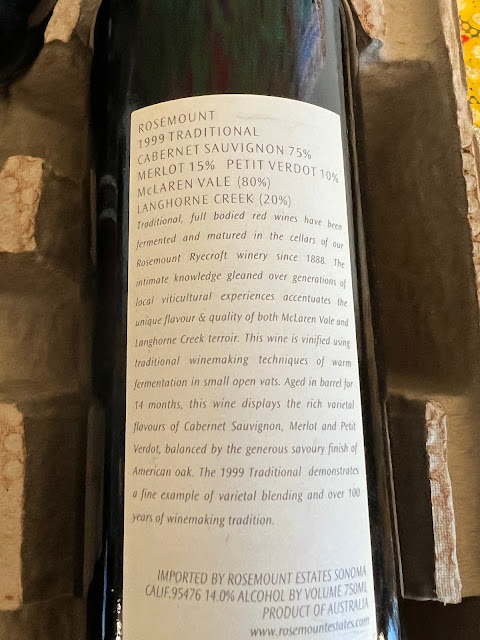
2. Rosemount Estates, Traditional Cabernet Sauvignon Merlot Petit Verdot, South Australia (McLaren Vale & Langhorne Creek )1999

Rosemount Estates, Traditional, South Australia 1999 © Spaswinefood

Rosemount Estates, Traditional, 1999 (back label) © Spaswinefood

Rosemount Estates Traditional Cabernet Sauvignon Merlot Petit Verdot, South Australia (McLaren Vale & Langhorne Creek )1999 (Cabernet Sauvignon 75%, Merlot 15%, Petit Verdot 10%) The average rating for 1999 vintage for this region was 89 - Very Good.


2022 Vintage Chart: In Decline - Pass Prime Drinking 


Conclusion: Yes, pass its prime


Overall the two Bordeaux style wines still showed good color for their age. Their taste did not hold up, as to be expected for this age. Needless to say, this will not discourage me from adding new Bordeaux wines to the cellar, such as 2018 Chateau Siran. 


Chateaux Siran 2018 © Spaswinefood

I plan to continue exploring Bordeaux wines, even old Bordeaux style wines. Obviously my goal will drink them before they pass their prime. I invite you to join me in my future wine adventures at Wine Travels with Dr. Sharon and at Spaswinefood  on  Twitter and Facebook. 


CHEERS!

Antigua, Guatemala 
Sharon
March 2022
© Spaswinefood


Red Bordeaux Wines © Spaswinefood
Discovery Session: Sweet Wines of Bordeaux, WMC21 © Spaswinefood

Follow me on Twitter and Facebook

Always a pleasure to return to Tablas Creek Vineyard, Paso Robles

I am off to Greece and bringing with me some Tablas Creek wines.  Tablas Creek Vineyard,  one of  Paso Robles  premier wineries, was one of ...