Showing posts with label #WMC21. Show all posts

Sunday, February 5, 2023

Bordeaux white wines are so much fun to discover

Picture yourself in Italy drinking French wines. That is, in this case some of the best Bordeaux white wines. YES, White Wines from Bordeaux! And, YES, Bordeaux is best known for its red wines.  Attending Discovery Sessions at the Wine Media Conference (#WMC22) at Lake Garda meant that we had the opportunity to taste wines from other European countries, in this case France.  

YES, White Wines © Spaswinefood

Discovering new wines is nirvana for #winelovers. I was among the attendees, in this case who got to taste, analyze, and write about the wines. Attending a Discovery Session is one of the highlights that I look forward to each year. Imagine if you combined discovering more about Bordeaux wines, by tasting its lesser known wines; that is, what made the White Wines of Bordeaux Discovery Session, So much fun, right? 

White Wines of Bordeaux

White Wines of Bordeaux © Spaswinefood

White Bordeaux (Bordeaux Blanc) is easily divided into two categories, dry and sweet. 
The session I attended focused on wine from some of the White Wine Bordeaux appellations.

White Wine Appellations of Bordeaux © Spaswinefood

These Bordeaux Appellations AOP's (Appellation d’Origine Protégée, formally known as AOC, or Appellation d’origine contrôlée) included: AOP Cadillac, AOP Loupac, AOP Sainte-Croix-du-Mont, AOP Côtes de Bordeaux, and AOP Bordeaux Moelleux.

White Wines of Bordeaux: Taking a Closer Look

Let us take a closer look at some of the wines featured during the White Wines of Bordeaux Discovery Session with Emma Baudry. When you think of Bordeaux you are most likely to think of Bordeaux's spectacular red wines, or maybe some of its awesome white wines. A tiny part of Bordeaux’s wine production is dedicated to white wines. Like the reds, white Bordeaux wines are usually blends, most commonly made with Sauvignon Blanc, Sémillon, and the rare Muscadelle. Other permitted grape varieties include Sauvignon gris, Ugni blanc, Colombard, Merlot blanc, Ondenc and Mauzac. Recently permitted by Bordeaux wineries, are  three new white grapes. These grapes are Alvarinho, Petit Manseng, and Liliorila. There are other less-known varieties used, such as Colombard and Ugni Blanc (the grape used in Cognac) however, most White Bordeaux wines are made of Semillon and Sauvignon Blanc. Sauvignon Blanc originated in Bordeaux; and it is very old, older than Cabernet Sauvignon.

Bordeaux, France

Tasting White Bordeaux Wines

The session introduced the following wines:

1.  Château de Jayle, Bordeaux Blanc Moelleux 2019

Château de Jayle, Bordeaux Blanc Moelleux 2019 © Spaswinefood

In the Glass: Château de Jayle, Bordeaux Blanc Moelleux 2019 © Spaswinefood

Château de Jayle, Bordeaux Blanc Moelleux 2019 © Spaswinefood

2.  Chateau Fayau, Sweet, Premieres Cotes de Bordeaux 2020

Chateau Fayau, Sweet, Premieres Cotes de Bordeaux 2020 © Spaswinefood

 Description: Sweet Chateau Fayau, Premieres Cotes de Bordeaux 2020 © Spaswinefood

3. Chateuax Garbes Cabanieu, Cadillac 2016

Description:  Chateuax Garbes Cabanieu, Cadillac 2016 © Spaswinefood

4. Chateau du Loupiac 2017

Chateau du Cros, AOC Loupiac 2016 © Spaswinefood

This wine is produced from 90% Semillon, with 5% Sauvignon Gris and % Sauvignon Blanc grapes. Deep gold in color, this full-bodied sweet Bordeaux on the nose has intense aromas of apricot, pineapple, orange marmalade, mango, apple, with hints of lychee and white peach. On the palate these flavors are complex with a long finish.  Available at around $22 this winehas the richness of Sauternes but it costs a fraction of the price. 


Available in the US at:
Calvert Woodley Fine Wines & Spirits, 4339 Connecticut Ave NW, Washington DC 2008 

Contacts : Michaël Sands,  Jennifer Sanders (WWW.calvertwoodley.com)

5. Chateau des Arroucats, Sainte-Croix-Du-Mont 2018

Chateau des Arroucats, Sainte-Croix-Du-Mont 2018 © Spaswinefood

 Chateau des Arroucats, Sainte-Croix-Du-Mont 2017

Description: Chateau des Arroucats, Sainte-Croix-Du-Mont © Spaswinefood

Produced from 92% Semillion, and 8% Sauvignon grapes this wine is medium gold in color. It is aromatic with tropical-fruit flavors of mango, pineapple, with hits of apple, pear, marmalade, and blossom. This medium-bodied Bordeaux has a medium to long finish, and has been described as having a creamy texture. It paired well with the blue cheese and dried apricots. Selling around $15 a bottle this another a fabulous Price Quality Ratio (PQR).


Available in the US at: Vintage Wine Marketing 

6. Chateau Majoureau, Cotes de Bordeaux Saint Macaire 2020

Chateau Majoureau, Cotes de Bordeaux Saint Macaire 2020 © Spaswinefood

Description: Chateau Marjoureau, Cotes de Bordeaux Saint Macaire © Spaswinefood

I found this #WMC22 Discovery Session to be very informative. Bordeaux white wines are so much fun to discover. It is so easy to fall in love with Bordeaux White Wines. Besides it's famous reds for sure Bordeaux whites deserve attention. Fortunately, my first introduction to these wines was at the Wine Media Conference #WMC21's Discovery Session on the Sweet Wines of Bordeaux. One of the best sources on Bordeaux White Wines is this article. I invite you to join me in our wine travels at Wine Travels with Dr. Sharon, and at Spaswinefood on Twitter and Facebook. 


CHEERS!


Sharon 
October 2022
La Garda, Italy 
© Spaswinefood

Overview of Bordeaux Wines


Bordeaux Red Wines

Left Bank Bordeaux Blend by law includes Cabernet Sauvignon, Merlot, Cabernet Franc, Petit Verdot, and Carmémere (rarely).


Right Bank Bordeaux Blend includes Merlot, Cabernet Franc, Cabernet Sauvignon


Bordeaux White Wines

A tiny part of Bordeaux’s wine production is dedicated to white wines. These wines are made with Sauvignon Blanc, Sémillon, and the rare Muscadelle.


Sauternes & Bordeaux Sweet Wines

Sauternes, the best-known French sweet wine, is from the Sauternais region of Graves in Bordeaux. Sauternes is made from Sémillon, Sauvignon blanc, and Muscadelle grapes that have been affected by Botrytis cinerea, also known as noble rot. The grapes become partially raisined, resulting in concentrated and distinctively flavored wines. Due to its climate, Sauternes is one of the few wine regions where infection with noble rot is a frequent occurrence. Even so, production can be a hit-or-miss proposition, resulting in varying harvests from vintage to vintage. Wines from Sauternes, especially the Premier Cru Supérieur estate Château d'Yquem, can be very expensive, largely due to the very high cost of production. Barsac lies within Sauternes and is entitled to use either name. Similar, but less expensive and typically less-distinguished sweet wines, are produced in the neighboring regions of Monbazillac, Cérons, Loupiac and Cadillac. In the United States a semi-generic label for sweet white dessert wines is known as sauterne without the "s" at the end and uncapitalized.


 Charming Taste of Europe © Spaswinefood

Follow me on Twitter and Facebook

Note: The above session that I attended was a Charming Taste of Europe's Discovery Sessions at the 2022 Wine Media Conference #WMC22. The mission of The Charming taste of Europe, co-funded by the European Union, to increase awareness of the merits and quality standards of select European wines and fresh fruits in the competitive markets of the United States of America and Canada. These French wines are produced with the artistry of agricultural traditions. Their campaign hopes to awaken the senses and a new culinary consciousness by connecting food, cultures, and territories and will undoubtedly bring European charm into the lives of many.

Monday, January 30, 2023

Pesaro: The perfect kick-off for a visit to Italy's Le Marche

Pesaro, by the seaside, was the perfect place to begin our Le Marche (pronounced Markay) wine country explorations. It's was mid-day when we picked up our car rental in Milan and headed to Pesaro on the Adriatic Sea. Le Marche wine region, on the eastern side of central Italy, is a coastal gem. Our journey to Le Marche was inspired after an introduction to this wine region at a Wine Media Conference (#WMC21) in Eugene, Oregon. After a relaxing stopover on the Adriatic, from there we headed inland to Maiolati Spontini. While in Maiolati Spontini area Verdicchio wine became the primary focus of our vine-filled adventures. 

Pesaro, on the Adriatic Sea © Spaswinefood

We were about to discovered that the Adriatic Sea city of Pesaro, the capital city of Pesaro and Urbino province, was the perfect introduction to the Marche region. In case you are wondering, the Adriatic Sea separates the Italian Peninsula from the Balkan Peninsula. It is the northernmost arm of the Mediterranean Sea. Countries, other than Italy, with coasts on the Adriatic include Albania, Bosnia and Herzegovina, Croatia, Montenegro, and Slovenia. Regrettably, our drive to Pesaro from Milan, which should have taken us three and half hours to drive, instead it turned into an over five hour drive because of heavy traffic. Finally, we checked into Gran Hotel Vittoria in city center around 6 pm. Fortunately, Pesaro was the ideal location to unwind for a few days. It was a much needed change of pace for this wine country traveler after attending a wine media conference (#WMC22 in Lake Garda), followed by a post-conference trip to Oltrepó Pavese.

Chilling in Pesaro
Arriving in Pesaro at the beginning of October meant the tourist season had already ended. While we love visiting without the tourists it does have its downside. The downside is some services are only available during the tourist season. Nevertheless, October in Pesaro is most ideal for a relaxing visit.

Beach Side In October, Pesaro © Spaswinefood
Finally Chilling in Pesaro © Spaswinefood

After searching for a restaurant that was open we even managed to find one with an ocean view.

Dining by the Seaside, Pesaro © Spaswinefood

During our Pesaro stay we enjoyed those relaxing walks around city center. 

 Exploring Pesaro © Spaswinefood
 Running Errands, Pesaro © Spaswinefood

I did manage to taste a few Le Marche wines while in Pesaro. Overall,  I was disappointed that the local restaurants offered very few Le Marche wines in the off-season. In most cases we had to order wines from other Italian wine regions.

During our stay we managed to check out a few local restaurants, such as Osteria Marconi.

Osteria Marconi © Spaswinefood

Since Oltrepó Pavese wines were still fresh in our minds from a recent visit we ordered: Cruase Metodo Classico, DOCG Oltrepó Pavese 2018.

 La Piotta Suspir, Cruase Metodo Classico, DOCG Oltrepó Pavese 2018 © Spaswinefood

  Pinot Nero Brut Rosé, Cruase Metodo Classico, DOCG Oltrepó Pavese 2018 © Spaswinefood

This Cruase DOCG Oltrepó Pavese Brut Rosé was a delight on that October afternoon. 

The salad was a big hit for us. 

  Salad, Osteria Marconi © Spaswinefood

Pesaro is a great place to order seafood and John did. If you love seafood Pesaro is the place.

Seafood Platter, Osteria Marconi © Spaswinefood

I ordered a vegetarian pasta.
 
Veggie Pasta, Osteria Marconi © Spaswinefood

It was a lovely late afternoon lunch. Tasty food and great service was what we appreciated.

Lunch, Osteria Marconi © Spaswinefood

We felt very welcomed at this restaurant. The waiter insisted on taking our photo.

CHEERS!  Osteria Marconi © Spaswinefood

After lunch we return to our seaside hotel.

Late Afternoon, Pesaro © Spaswinefood

After a relaxing visit to Pesaro, on the eastern side of central Italy, we can certainly see why it  is considered to be Italy’s coastal gem. From Pesaro we traveled inland to Maiolati Spontini to discover Le Marche wine country.

Why Le Marche?
Our journey to Le Marche was inspired after learning about this region at a Wine Media Conference (#WMC21). Winemaking in Marche dates back thousands of years, being influenced by Etruscans, Romans and Lombards. While Le Marche is best known for its white wines Trebbiano and Verdicchio, it is also home to some big quality reds. Some of Italy’s finest Marche red wines are made with Montepulciano and Sangiovese grapes. We were about to discover that Italy's Le Marche is ideal for making wine discoveries off the beaten path.


Italy's Marche Wine Country © Spaswinefood

The Marche region is divided into five provinces: Ancona, Ascoli Piceno, Fermo, Macerata, and Pesaro and Urbino. Within each of the provinces there is much to discover. 

Why Le Marche, Italy © Spaswinefood

While sometimes Le Marche is overshadowed by its neighbors Abruzzo to the south, and Umbria and Tuscany to the west, this wine region produces great wines. It is home to 15 DOCs and 5 DOCGs.


Marche Wine Appellations © Spaswinefood

Later in Le Marche's Maiolati Spontini area we explored Verdicchio dei Castilli di Jesi wine country. Discovering Verdicchio dei Castelli di Jesi became the primary focus on our recent Le Marche wine travels.


Maiolati Spontini, Le Marche © Spaswinefood


 Maiolati Spontini © Spaswinefood

After leaving Pesaro it was a pleasant drive from the coast inland to wine country. We loved our vine-filled explorations in Le Marche's Verdicchio dei Castilli di Jesi DOC. Time to relax in Pesaro and those special Le Marche welcomes along the way added so much to our travel memories of Italy.  I am happy that after our first introduction to these wines we made plans to go to Le Marche wine country. Undoubtedly that Wine Media #WMC21 session Le Marche, the "new Tuscany" in Central Italy certainly was a hit for us. It prompted us to head to Italy's Marche. We have since discovered that not only are there great wines but some of Italy's best cheeses are in Le Marche. Le Marche was absolutely the perfect introduction to making wine discoveries off the beaten path in Italy. Wine travelers who discover this region will be impressed by the charm of its towns and wineries. I so look forward to sharing more on our Italian vine-filled explorations. I invite you to join me in my wine travels in Italy at Wine Travels with Dr. Sharon, and at Spaswinefood on Twitter and Facebook. 


CHEERS!


Sharon 
October 2022
Marche, Italy 

© Spaswinefood

Pesaro by the Seaside © Spaswinefood


October Seaside Walk, Pesaro  © Spaswinefood


Why Visit Le Marche © Spaswinefood

Follow me on Twitter and Facebook  

Monday, December 12, 2022

Italy's Le Marche inspires you to continue making wine discoveries off the beaten path

Our journey to Le Marche (pronounced Markay) was inspired after learning about this region at a Wine Media Conference (#WMC21). Le Marche on the eastern side of central Italy is considered to be Italy’s coastal gem. Winemaking here dates back thousands of years, being influenced by Etruscans, Romans and Lombards. While Le Marche is best known for its white wines Trebbiano and Verdicchio, it is also home to some big quality reds. Some of Italy’s finest Marche red wines is made with Montepulciano and Sangiovese grapes. During our October Le Marche travels we would stop in Pesaro, and Maiolati Spontini.  Italy's Le Marche is ideal for making wine discoveries off the beaten path.


Italy's Marche Wine Country © Spaswinefood


Verdicchio dei Castelli di Jesi was my primary focus on our Le Marche wine travels.

Italy's Marche Wine Country
The Marche region is divided into five provinces: Ancona, Ascoli Piceno, Fermo, Macerata, and Pesaro e Urbino. Within each of the provinces there is much to discover. While sometimes Le Marche is overshadowed by its neighbors Abruzzo to the south, and Umbria and Tuscany to the west, this wine region is home to 15 DOCs and 5 DOCGs. 


Marche Wine Appellations © Spaswinefood

After our two-day visit to Pesaro on the coast, we headed inland to Maiolati Spontini for two days before traveling onto Umbria. While in Maiolati Spontini area we explored Verdicchio dei Castilli di Jesi wine country.


Maiolati Spontini, Le Marche © Spaswinefood


 Maiolati Spontini © Spaswinefood


Welcome to Verdicchio dei Castilli di Jesi


Verdicchio dei Castelli di Jesi, a white-wine DOC in the Marche region, is home to dry white wines made from the ancient Verdicchio grape variety. Verdicchio means little green one. Besides dry whites, other forms of Verdicchio dei Castelli di Jesi include passito wines made from dried grapes (may be either sweet or dry) and spumante, which are made using either the Charmat method or methode traditionnelle. The DOC has a superior classico sub-zone. The Verdicchio dei Castelli di Jesi Superiore designation denotes wines with an extra 0.5 percent of alcohol. Verdicchio dei Castelli di Jesi Riserva can be given a separate higher DOCG status.


The dry white wines are typically straw colored with pronounced green tinges, with a green aroma profile (herbaceous notes and fresh apples). They have crisp acidity and a pleasant, slightly bitter aftertaste redolent of toasted almonds. The wine is an ideal match with regional seafood dishes, such as Brodetto di Pesce (a rich seafood stew like bouillabaisse), or cheeses, such as pecorino.


This wine area is characterized by hilly territory around the town of Jesi, Ancona province. The terroir is ideal for the production of mineral-tinged dry white wines, mostly to its calcareous, clay and limestone-rich soils and a relatively dry maritime climate.


The area’s temperate climate is due to Jesi's proximity to the Adriatic, and to various local rivers such as the Cesano and Esino. The east-west passage of the rivers and their corresponding valleys provide the area with persistent gentle winds, onshore during the morning and offshore in the late afternoon. This constant ventilation helps prevent the onset of fungal diseases such as grey rot and mildew.

Verdicchio wines from Jesi and its neighbors is markedly softer and more rounded than those produced in Matelica to the south. Verdicchio di Matelica usually needs several years of aging to relax its sharper character. In contrast Verdicchio dei Castelli di Jesi is approachable within the early months of its life.


We visited three Verdicchio dei Castilli di Jesi wineries.


Wine Stops, Verdicchio dei Castilli di Jesi DOC  © Spaswinefood

Overall this was a beautiful drive through the countryside while learning about some of the wines produced here.


Intro to Verdicchio dei Castilli di Jesi DOC Wineries


1. AZ Agricola Sabbionare, Montecarotio


Welcome to Sabbionare © Spaswinefood

When we arrived at Sabbionare we went inside and received a warm welcome. The wine tasting included:


(1) Sabbionare, il Filettò, Verdicchio dei Castilli di Jesi DOC Classico 2021

Sabbionare, il Filettò, Verdicchio dei Castilli di Jesi DOC Classico 2021 © Spaswinefood

This dry white Veerdicchio wine is typical of the DOC Classico hoverer, other forms of Verdicchio dei Castelli di Jesi passito and spumante wines are also produced.

2. Sabbionare, Verdicchio dei Castilli di Jesi DOC Classico Superiore 2020

 Sabbionare, Verdicchio dei Castilli di Jesi DOC Classico Superiore 2020 © Spaswinefood

These two Verdicchio wines were a great introduction to the region.

Sabbionare, Verdicchio dei Castilli di Jesi DOC Wines © Spaswinefood

Verdicchio dei Castelli di Jesi Superiore wines require an extra 0.5 percent of alcohol. In this case 
Il Filettò, Verdicchio dei Castilli di Jesi DOC Classico 2021 shows 13% alcohol versus the Sabbionare, Verdicchio dei Castilli di Jesi DOC Classico Superiore 2020 shows 14% alcohol.

3. Sabbionare, Ribotta Esino Rosso DOC 2021

Sabbionare, Ribotta Esino Rosso DOC 2021 © Spaswinefood

Sabbionare, Ribotta Rosso Esino DOC 2021 © Spaswinefood


The Ribotta Esino Rosso is a blend of Multipluciano and Sangiovese. Esino DOC is the zone stretching from Ancona, in the West, along the river Esino and parts of the Macerata province, namely the same area where the Verdicchio wines are grown.


4.  Sabbionare, Cromia Marche Rosso IGT 2021

 Sabbionare, Cromia Marche Rosso IGT 2021 © Spaswinefood

Cromia is a blend of Montepulciano 90% Merlot 10%. Marche IGT is used in the Marche wine region. This designation covers a wide range of wine styles (still, sparkling, sweet, etc.). For example Marche IGT Bianco may be made from any of the grape varieties approved for white wine in Marche. Marche IGT Rosato and Rosso have the same flexibility with authorized red grapes. The result is a large number varieties are allowed for single-variety and double-variety labeled wines.


Our wonderful Sabbionare host that morning took us to the back patio to view their vineyard. This was our first stop for the day and so I did not linger as long as I should have.


Spaswinefood Moments, Sabbionare Vineyard © Spaswinefood


It was a delight to take in the vineyard views at Sabbionare winery.


 Sabbionare Vineyard © Spaswinefood

 Sabbionare Vineyard © Spaswinefood


It was back into the car and onto our next stop. Soon we arrived at Cantina Sartarelli where they were busy attending to the harvest. 


2. Cantina Sartarelli, Poggio San Marcello


 Views from Cantina Sartarelli  © Spaswinefood


Upon arriving at Sartarelli I checked out the stunning views.


 Cantina Sartarelli, Poggio San Marcello © Spaswinefood


Cantina Satarelli is a very inviting family winery that has chosen to produce only Verdicchio. In Verdicchio Veritas is proudly displayed on the wall in the tasting room at Satarelli. 


Sartarelli Verdicchio Wines © Spaswinefood


During our Cantina Sartarelli visit we tasted the following four wines:


(1) Sartarelli, Verdicchio dei Castilli di Jesi DOC Classico 2021


Verdicchio dei Castilli di Jesi DOC Classico 2021 © Spaswinefood


(2) Sartarelli, Travilio Verdicchio dei Castilli di Jesi DOC Classico Superiore 2020

Travilio Verdicchio dei Castilli di Jesi DOC Classico Superiore 2020 © Spaswinefood


3.  Sartarelli,  Ballancia Verdicchio dei Castilli di Jesi Classico Superiore DOC 2019

Ballancia Verdicchio dei Castilli di Jesi Classico Superiore DOC 2019 © Spaswinefood


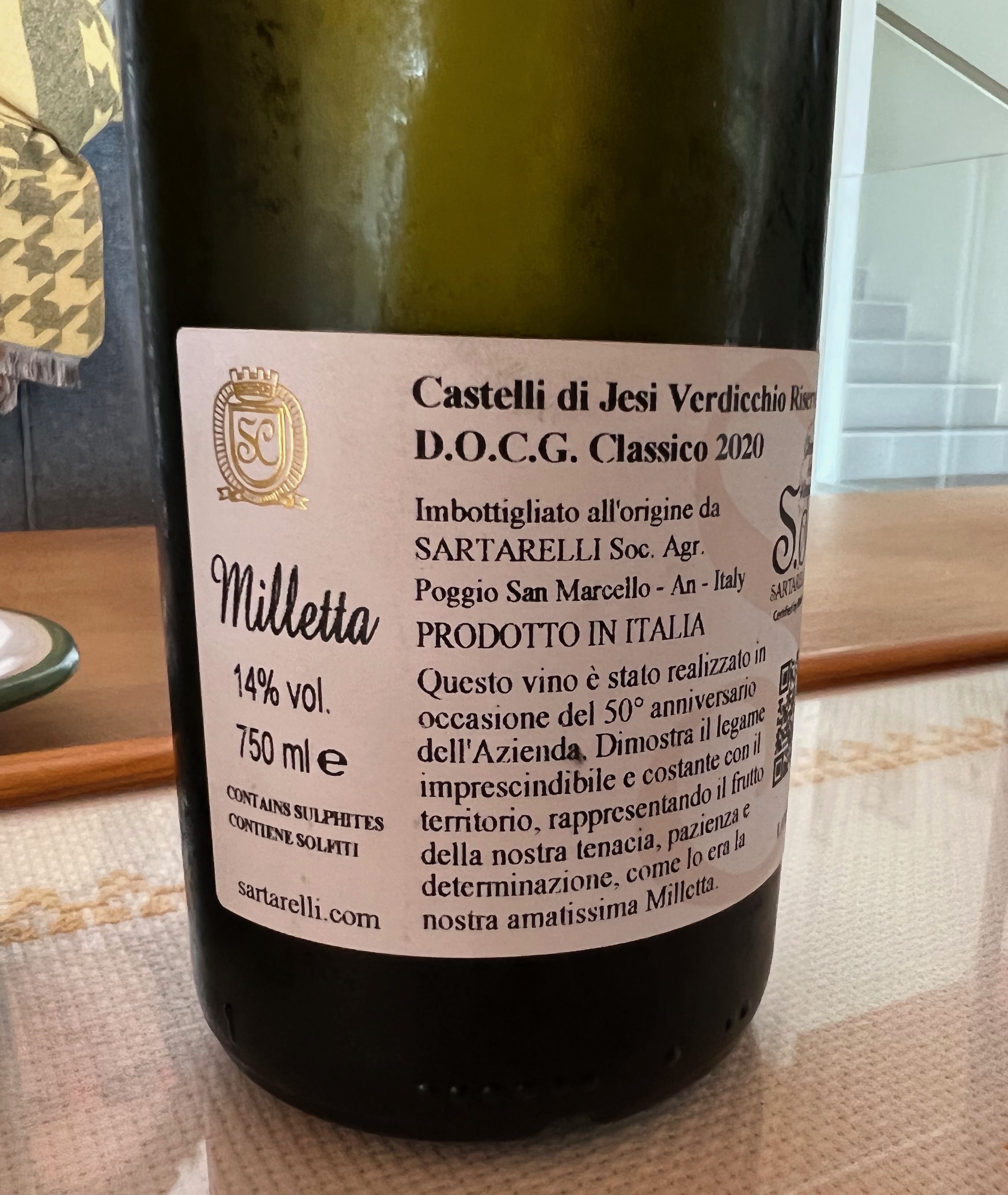
(4) Sartarelli, Milletta Verdicchio dei Castilli di Jesi Riserva Classico DOCG 2020

 Milletta Verdicchio dei Castilli di Jesi Riserva Classico DOCG 2020 © Spaswinefood

Milletta Verdicchio dei Castilli di Jesi Riserva Classico DOCG 2020 © Spaswinefood

This winery was an inviting place to visit.


Cantina Sartarelli, Le Marche  © Spaswinefood

Taking a Closer Look, Cantina Sartarelli © Spaswinefood


Besides taking in the vineyards views the local architecture of the winery buildings also captured our attention.


Exploring Le Marche  © Spaswinefood


I always welcomed taking in the winery views while touring Le Marche.


Le Marche's Cantina Sartarelli © Spaswinefood


After two excellent winery visits we headed to lunch. This area of Marche has many excellent restaurant options. After lunch off we went to the next winery.


Marche's Landscape in October © Spaswinefood


I loved not only visiting the wineries but seeing Marche's landscape in early October.


AZ Agricola Pievalta, Maiolati Spontini, Marche © Spaswinefood


3. AZ Agricola Pievalta, Maiolati Spontini


AZ Agricola Pievalta is a biodynamic winery. We stopped by this winery twice but the tasting room was not open; so we did not get to taste their wines. 


AZ Agricola Pievalta © Spaswinefood


Tasting Room, AZ Agricola Pievalta © Spaswinefood

Despite not being able to taste their we did enjoy touring Le Marche's stunning, hilly landscape.


Vineyard at AZ Agricola Pievalta © Spaswinefood


More on Maiolati Spontini Area

While in the area we also checked out La Locanda Hostaria della Posta. In fact, we went there on the first day we arrived in the area.


Time for Verdicchio, Hosteria Della Posta © Spaswinefood


It was a lovely late afternoon lunch.


While in Maiolati Spontini we stayed at La Torre Hotel. Out last evening there we decided to enjoy some cheese and crackers with a bottle of Torti Wines Route 66 wine. The hotel staff seeing us setting outside brought us a complementary platter to enjoy.


Time for Wine, La Torre Hotel © Spaswinefood

Thanks La Torre Hotel © Spaswinefood


La Torre Hotel © Spaswinefood


We loved our vine-filled explorations in Le Marche's Verdicchio dei Castilli di Jesi DOC. Those special welcomes that we received along the way added so much to our travel memories of Italy. We were inspired to visit this region after the 2021 Wine Media Conference (#WMC21) session Le Marche, the "new Tuscany" in Central Italy. It certainly was a  hit for us. That session in Eugene, Oregon when we first explored wines from Marche's wine appellations (Verdicchio dei Castilli di Jesi, Lacrima di Morro d'Alba, Rosso Piceno DOC's, and DOCG Pecorino). Upon learning about this wine region and tasting some Le Marche wines we just had to visit. After our first introduction to these wines we made plans to go to Le Marche wine country. When we did Verdicchio dei Castilli di Jesi DOC, the primary focus for our visit to Le Marche, was absolutely perfect introduction to making wine discoveries off the beaten path in Italy. Wine travelers who discover this area will be impressed by the charm of its towns and wineries.  Indeed Le Marche wine inspires adventures, which must continue soon. I so look forward to sharing more on our vine-filled explorations in Italy and elsewhere at Wine Travels with Dr. Sharon and at Spaswinefood  on  Twitter and Facebook.  


CHEERS!


Sharon

October 2022

Le Marche, Italy 

© Spaswinefood


In case you are still wondering Why Le Marche? Here's why!


Why Visit Le Marche © Spaswinefood


More on - Why Visit Le Marche? 

During #WMC21 we explored wines from Marche's wine appellations of Verdicchio dei Castilli di Jesi, Lacrima di Morro d'Alba, and Rosso Piceno DOC's, and DOCG Pecorino. After learning about this wine region and tasting some Le Marche wines it inspired us to visit. 

Enjoying Le Marche Wine at the South Rim, Grand Canyon © Spaswinefood

Off the Wine Road 
Does where you drink wine make a difference? For sure drinking a Le Marche wine at edge of the Grand Canyon was an ideal setting. It was also perfect timing for reflecting on an earlier tasting of Le Marche wines.
Exploring Le Marche Wines, #WMC21 © Spaswinefood

For sure tasting these wines makes you want to know more about this Italian wine region.

Tasting Marche Wines 

Earlier during the session conference attendees were introduced to wines by Velenosivini. Let's take a closer look at these Le Marche wines. The four Velenosi Ascoli Piceno wines tasted were:


1. Verdicchio Querciantica, Dei Castilli Di Jesi DOC Classico

Verdicchio Querciantica, Dei Castilli Di Jesi DOC Classico © Spaswinefood

Verdicchio ripens slowly, it is high in tartaric acid, and does well with aging in oak. This very versatile grape  allows it to be made in many styles (dry, sweet and sparkling). It is a complex wine, characterized by aromas of fruit - peach, lemon, apple, pear, and yellow plums; floral- acacia, hawthorn, chamomile, white flower; herbs- dill, thyme, anise, basil, coriander; terry- almond, honey, beeswax, lees, Unami; minerals - iodine, flint, sea spray, petrol.  While this wine is delightful young it can age, allowing for complexity, harmony and depth as it matures.

The following slide describes Verdicchio dei Castilli di Jesi DOC:
Verdicchio di Castilli di Jesi DOC © Spaswinefood

2. Villa Angela, Offida DOCG Pecorino

Villa Angela, Offida DOCG Pecorino © Spaswinefood

Pecorino, white grape variety, grows in the Marche, Abruzzo, Tuscany, Umbria and Lazio regions of Italy. Pecorino is a very old variety. Ampelographers believe that the grape is likely native to Marche. It likely originated as a wild grapevine growing in the Sibillini Mountains, and later was domesticated for wine production. This once nearly extinct grapes has been under going a revival.

Pecorino grapes ripen early. It has been described as straw yellow, having good structure, high acidity, dry with mineral characteristics and a salty undertone. This medium body wine can have fruity aromas of apple, pear, candied orange, and tropical fruit, herbal aromas (sage, mint and thyme), and a floral bouquet (such as acacia, jasmine and linden flowers). 

How Did Pecorino Wine Get Its Name?
Historically this grape has ties to local shepherds (Pecora is Italian for sheep). There are interesting stories of how the grape got its name. It is thought that sheep nibbled on these grapes as the shepherds took care of their flock. Given that Pecorino is also a name for a cheese, one version of the story is - the shepherds compensated the vineyard owners for the grapes that the sheep ate with Pecorino cheese. Yes, Pecorino is a type of cheese. Another explanation is the shape of the grape bunches resembles a sheep's head.

Pecorino is one of the most common grape varieties in Le Marche. It is considered to be one of Italy's wine success stories of 21st century. Maybe native to Sibling Mountain area. It was abandoned and rediscovered at Arquata. Officially recognized as a wine in 1990, DOC in 2001, and DOCG in 2011.
DOCG Pecorino, Le Marche © Spaswinefood


Le Marche's Offida Pecorino DOCG requires that for Pecorino to be made as a varietal it has to make up at least 85% of the blend, with other local, non-aromatic grapes, being permitted for the remainder.


3. Querciantica Lacrima Di Morro DOC

Querciantica Lacrima Di Morro DOC © Spaswinefood


Lacrima means tear in Italian. The grape gets its name because when the grape ripens it has a thin skin, which can easily break. Given its skin breaks easily this makes it vulnerable to pests and disease. For that and other reasons it was almost abandoned, with it being rescued in 1980's and made a DOC in 1985. The characteristics of this aromatic variety include; fruit (black cherry, dark berry); floral (violets, lavender and rose buds); and spice (cinnamon, nutmeg, ginger). This wine has an intense ruby red color with violet hues. On palette the wine is dry with medium tannins and lingering rich flavors. 


The following slide describes Lacrima Di Morro d'Alba DOC:

Lacrima Di Morro d'Alba DOC © Spaswinefood
 

4. Roggio Del Filare, Rosso Piceno DOC Superioré 2017

Roggio Del Filare, Rosso Piceno DOC Superioré © Spaswinefood

Rosso Piceno DOC Superioré © Spaswinefood


This 
Roggio Del Filare wine is a bright ruby red wine with slight garnet hues. It is made using 70% 
Montepulciano and 30% Sangiovese grapes. Obviously the characteristics of this Roggio Del Filare wine is influenced by the grapes that are used to make it.  Now for a brief look at the characteristics of Montepulciano and Sangiovese grapes. 

Characteristics of Montepulciano and Sangiovese Grapes © Spaswinefood


The wine has an  intense bouquet of ripe plums and cherries, with spices and floral nuances. On the palette this full bodied wine has strong texture, rounded tannins, with a warm, lingering velvety pulp and spicy finish.

The following slide summarizes the Rosso Picino Superioré DOC:

Rosso Picino Superioré DOC © Spaswinefood


As I noted earlier that Wine Media #WMC21 session Le Marche, the "new Tuscany" in Central Italy, prompted us to go to Italy's Marche wine country to learn about its inviting wines. We have since discovered that not only are there great wines but some of Italy's best cheeses are in Le Marche.  I invite you to join me in future wine adventures in Italy and elsewhere at Wine Travels with Dr. Sharon and at Spaswinefood  on  Twitter and Facebook. 


CHEERS!


Sharon

Follow me on Twitter and Facebook 

Always a pleasure to return to Tablas Creek Vineyard, Paso Robles

I am off to Greece and bringing with me some Tablas Creek wines.  Tablas Creek Vineyard,  one of  Paso Robles  premier wineries, was one of ...