Monday, January 23, 2023

Getting to know Umbria: Off to Orvieto

Orvieto, the Umbrian city from which the surrounding wine region takes its name, is perched atop an outcrop of volcanic rock. Our Orvieto wine country explorations took us through hilly landscapes, passing endless vineyards along the way. This post highlights our visit to this historic city, which dates back to the Etruscan era, long before it became a stronghold of the Roman Empire. Underneath Orvieto's cobbled alleyways and medieval piazzas, there is a network of underground caves dating back to the city’s ancient origins. It was in these underground cellars that the Etruscans produced the first wines for Orvieto clergy. The city is surrounded by sweeping hills and fields of vineyards as far as the eye can see. During our visit to Orvieto we explored its historic center, and took in panoramic views of the surrounding countryside.

Giardini Comunali di Orvieto, Orvieto © Spaswinefood


Getting to Know Orvieto

A stop at Giardini Comunali di Orvieto before entering the city center is a good idea however, we did it at the end. Either way it is a must visit to take in the views. A large tuff stone arch is at the main entrance. From this site you get incredible views overlooking the Paglia river and the surrounding Umbrian countryside. Umbria is defined by hills, mountains, valleys and historical towns such Orvieto, Todi, and other small cities/villages. It is often referred to as the green heart of Italy where travelers delight in exploring its medieval hilltop towns, dense forests, and local cuisine (especially truffles and wines). When we visited Decugnano Dei Barbi in Orvieto wine country, from there we saw this historic city in the distance. Once you see the city of Orvieto in the distance you are compelled to visit, and we did.

Orvieto in the Distance © Spaswinefood

A Closer Look at Orvieto in the Distance © Spaswinefood

Orvieto, the city from which the wine region takes its name, is perched atop an outcrop of volcanic rock. The Orvieto Citadel can be seen for many miles around. Winemaking began here during the Etruscan era when a network of underground caves was established. Today, winemaking is a cornerstone of Orvieto’s economy, and the city is surrounded by sweeping hills and fields of vineyards as far as the eye can see. Orvieto is Umbria’s most productive wine area, accounting for around 80% of Umbria’s total vineyard area. 

Views below Giardini Comunali di Orvieto © Spaswinefood

Views from Giardini Comunali di Orvieto © Spaswinefood

Orvieto's Historic Center

After we arrived in the parking lot at the outskirts of historic center we head towards the historic center, which is pedestrian friendly.

Off to Orvieto City Center © Spaswinefood

Off we went to the historic town center.

Walking Cobblestone Streets towards City Center © Spaswinefood

Soon we are heading down even narrower streets.

Checking out Orvieto Restaurants © Spaswinefood

Taking a Closer Look, Orvieto © Spaswinefood

This beautiful historic, culturally rich town also has great cuisine. Our visit was perfectly timed for lunch.

Orvieto for Lunch
We had a short list of restaurant options for lunch to checkout.

Antica Cantina, Orvieto © Spaswinefood

After checking our some options on our list we settled for Antico Bucchero.

Antico Bucchero, Orvieto © Spaswinefood

Antico Bucchero, Orvieto © Spaswinefood

Every time we dined out in Umbria we made an effort to try the local wines. Orvieto’s most famous wines are whites, made from blends of Grechetto and Trebbiano grapes. For a wine to be certified Orvieto DOC, it must consist of at least 60% of this blend.

Salad & Wine, Antico Bucchero © Spaswinefood

Now here are the pastas we had.

Pasta with Meat, Antico Bucchero © Spaswinefood
Veggie Pasta, Antico Bucchero © Spaswinefood

I am sure we shared a dessert. We were quite please with our lunch option. Obviously, we need more time to explore both cuisine and the city. I suppose, that would a good reason to return in the future.

 
Antico Buccher, Orvieto © Spaswinefood

After lunch we headed back to the parking lot, enjoying historic Orvieto along the way. Along the way we spotted historical buildings, language schools and more.

Leaving Orvieto  © Spaswinefood

Waiting outside Language School, Orvieto © Spaswinefood

We  dropped by Giardini Comunali di Orvieto to take in the panoramic views before driving back to our accommodations in Izzalini. Our week in Umbria passed far too quickly, as we visited its historic towns and explored wine country. Umbria is a region with a proud history and age-old tradition for winemaking. Moreover, the area can rival anywhere in the country for its natural beauty. Other than Orvieto wine country Umbria’s best known wine sub-regions also include Assisi, and Montefalco. My earlier articles focused on winery visits in Orvieto wine country and Montefalco. I invite you to join me in our wine travels in Italy and elsewhere at Wine Travels with Dr. Sharon, and at Spaswinefood on Twitter and Facebook. I am so looking forward to sharing our vine-filled explorations in Italy. 


CHEERS!


Sharon 
October 2022
Orvieto, Umbria
Italy 
© Spaswinefood

Giardini Comunali di Orvieto © Spaswinefood
Orvieto City Center © Spaswinefood

Thursday, January 19, 2023

Getting to know Izzalini: A hilltop village in Umbria, Italy

Before heading to Italy we decided to add Umbria to our wine country travel plans. Umbria is defined by hills, mountains, valleys and historical towns such Perugia, Assisi, Terni, Norcia, Città di Castello, Gubbio, Spoleto, Orvieto, Todi, Castiglione del Lago, Narni, Amelia, Spello, and other small cities/villages. It is often referred to as the green heart of Italy where travelers delight in exploring its medieval hilltop towns, dense forests, and local cuisine (especially truffles and wines). We managed to secure accommodations in Izzalini, close to the historic town of Todi. Yes, we stayed in a castle in Izzalini village, not far from Todi. We loved getting to know the hilltop village of Izzalini.

Castello Izzalini Todi Resort, Umbria © Spaswinefood

First, just a little information on Izzalini:  Izzalini village is within the municipality of Todi ( 5.81 kilometers from Todi), in Perugia Province, Umbria region. During our week's visit we stayed in a one bedroom apartment at the Castello Izzalini Todi Resort. I still remember waking up those October mornings and taking in the views from our bedroom window. Some of those days we could see early morning fog across the valleys in the distance.

Early Morning Fog, Izzalini, Umbria © Spaswinefood

October Morning Fog, Umbria © Spaswinefood

Sunrise Through the Morning Fog, Umbria © Spaswinefood

Then through the other window a view towards the village square.

View towards Village Square, Castello Izzalini © Spaswinefood

I would keep a watch out for the kittens that would sometimes appear in the courtyard below our window.

Grape Vine, Castello Izzalini © Spaswinefood

Each day we would head out to explore Umbria. We always loved returning to Izzalini at the end of the day, after we explored Montefalco and Orvieto wine country.

 Izzalini Village, Umbria © Spaswinefood
Castello Izzalini, Umbria © Spaswinefood

Exploring Local Cuisine

Overall dining out in Italy is pretty amazing, especially if you stick to local restaurants.  This is certainly the case in Umbria. Correspondence we received concerning our accommodations noted there was a good restaurant in the village. After arriving we set out to explore Umbria paying little attention to this recommendation. We did drop by for a morning coffee. Then about mid-way through our stay we dropped by for lunch.

Morning Coffee

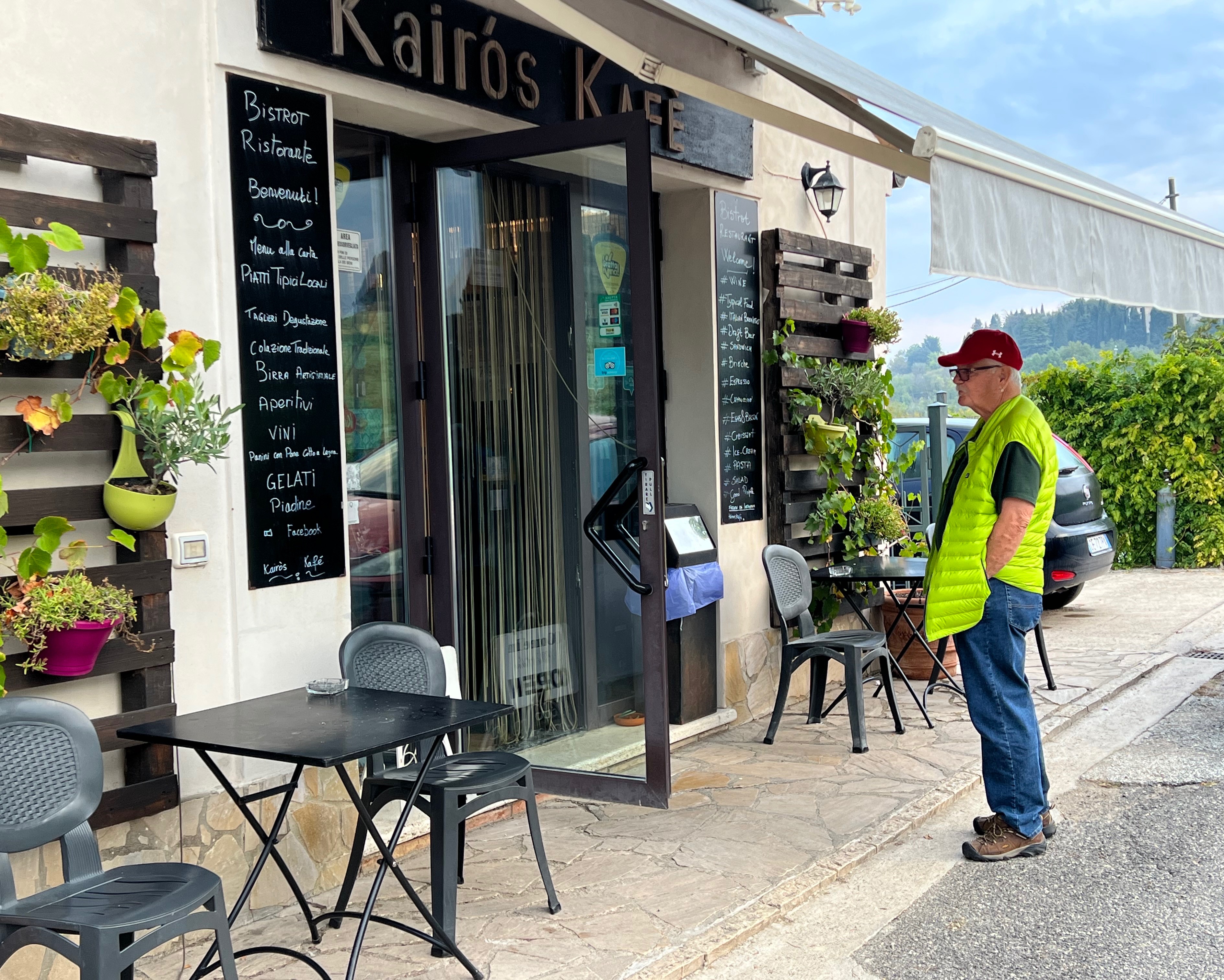
Off to Kairos Kafe, Izzalini © Spaswinefood
Kairos Kafe, Izzalini, Umbria © Spaswinefood

Coffee is good in Italy however, if you are use to a big cup of coffee it takes some practise to know what to order. Most of the locals order an expresso.

Morning Coffee, Kairos Cafe, Umbria © Spaswinefood
Kairos Cafe, Umbria © Spaswinefood

Lunch and More

Returning later for lunch we would be delightfully surprised.

Kairos Cafe, Umbria © Spaswinefood

Kairos Cafe, Umbria © Spaswinefood

We began with a complimentary appetizer.

Appetizer, Kairos Cafe © Spaswinefood

For lunch we ordered a local white wine. John decided on a green salad and I ordered chickpea salad.

Local Wine & Salad, Kairos Cafe © Spaswinefood
Chickpea Salad, Kairos Cafe  © Spaswinefood

Now for the mains John ordered a meat dish and I decided on a pasta.

Lunch at Kairos Cafe © Spaswinefood

Savoring the Details, Kairos Cafe © Spaswinefood

Mine was an amazing pasta dish

Gnocchi, Kairos Kafe  © Spaswinefood

The Best Gnocchi, Kairos Kafe © Spaswinefood

We had one of our best lunches in Italy there.

Tasting Local Wines, Kairos Kafe © Spaswinefood

Of course after a lunch like that we returned for dinner on the last evening of our stay. Besides returning for dinner the morning we left to drive to Modena we picked up a morning coffee.

Coffee to Go, Kairos Kafe © Spaswinefood

The hilltop village of Izzalini was a perfect base for exploring Umbrian wine country. Being off the tourist beaten path led to pleasant drives through the rural countryside to visit wineries and Umbria's historic towns.

Map of Todi Municipality, Umbria © Spaswinefood


Our week in Umbria passed too quickly as we visited its historic towns and checked out wine country. Umbria is a region with a proud history and age-old tradition for winemaking. Moreover, the area can rival anywhere in the country for its natural beauty. An earlier article focused on Montefalco as a productive wine area. I invite you to join me in our wine travels in Italy and elsewhere at Wine Travels with Dr. Sharon, and at Spaswinefood on Twitter and Facebook.


CHEERS!


Sharon 
October 2022
Umbria, Italy 
© Spaswinefood

Castello Izzalini, Umbria © Spaswinefood

Castello Izzalini, Umbria © Spaswinefood
In/Near Todi © Spaswinefood

Thursday, January 12, 2023

The Pure Magic of Decugnano Dei Barbi in Umbria's Orvieto

Decugnano Dei Barbi in Umbria's Orvieto was well worth the drive from Todi.  Shortly after our arrival we set out to explore wine country. The week passed too quickly, as we visited the sub-regions of Umbria's wine country, and the region’s historic towns, like Todi and Orvieto. Our explorations took us through hilly landscapes, passing endless vineyards along the way. When I short listed Orvieto wineries to visit I put Decugnano Dei Barbi, and two others (Madonna del Latte and Cantine Neri) on the list. I reached out, and in the end  Decugnano Dei Barbi, a boutique family winery, was able to schedule a time for us. 

Santa Maria di Decugnano Church, Decugnano Dei Barbi © Spaswinefood

The Special Magic of Decugnano Dei Barbi

Decugnano Dei Barbi is, not only a place with great views and amazing wines but, also a place of historical and geological significance. From its hilltop position you have panoramic views all the way to Orvieto. Decugnano Dei Barbi sits on the captivating site of a 13th century hilltop village where monks once produced wine for Orvieto clergy. Decugnano Dei Barbi is a family-run winery that stays true to its roots. The site is located on the grounds of Santa Maria di Decugnano Church, hence the name. It was restored in 1973 following the Italian boom in the 1960s. 

Orvieto in the Distance, Decugnano Dei Barbi © Spaswinefood

Decugnano Dei Barbi is located in the Orvieto wine region that takes its name from Orvieto, the city. The city is perched atop an outcrop of volcanic rock. In fact Orvieto's Citadel can be seen for many miles around. From the hilltop at Decugnano Dei Barbi there are distance views. The city dates back to the Etruscan era, long before it became a stronghold of the Roman Empire. Underneath the cobbled alleyways and medieval piazzas of the city there is a network of underground caves, which dates back to the city’s ancient origins. These underground cellars is where the Etruscans produced the first wine in Orvieto. Today, winemaking is a cornerstone of Orvieto’s economy, and the city is surrounded by sweeping hills and fields of vineyards as far as the eye can see. Orvieto is Umbria’s most productive wine area, accounting for around 80% of Umbria’s total vineyard area. 


Along the way to Decugnano Dei Barbi we took in views of Orvieto perched atop a volcanic rock outcrop in the distance.


Orvieto in the Distance © Spaswinefood


After driving for over an hour on winding roads through the countryside we finally arrived at the winery entrance. 


Entrance to Decugnano Dei Barbi © Spaswinefood

Welcome to Decugnano Dei Barbi © Spaswinefood


Our Visit to Decugnano Dei Barbi 

The drive up to the estate entrance was a beautiful one, winding through the Umbrian countryside.  Our host, greeted us with a warm welcome. The Barbi family began by producing wines originally for the pleasure of family and friends. After ten years their wines began to win awards. This success prompted Decugnano Dei Barbi to expand production, and offer tours and tastings. It is now a boutique winery, run by the Barbi family.


October Vineyard © Spaswinefood
Leaves Changing, Decugnano Dei Barbi Vineyard © Spaswinefood
Vineyard & Valley Views © Spaswinefood

When we walked by the vineyards, our host explained how the soil we were standing on was once the bed of the Mediterranean Sea. Even though that was millions of years ago, we could still see shells in the ground, and later we viewed fossils in the walls of the cellar caves. These unique vineyard growing conditions add more minerals and salt to the wine in comparison to other producers across the valley.


We also toured the production facility before the tasting.


Tank Room, Decugnano Dei Barbi © Spaswinefood

The winery is equipped to do from small batch to regular volume wine productions.

Touring Decugnano Dei Barbi Winery © Spaswinefood

Tank Room Details, Decugnano Dei Barbi © Spaswinefood

Later, we walked up to the site of the old church, which has been carefully restored and updated to host tastings. From the church there were spectacular views across the Umbrian valleys.


 Santa Maria di Decugnano Church, Decugnano Dei Barbi © Spaswinefood


Our tasting at a church was unique. When you enter the carefully restored church you are immediately struck by the beauty of the setting.


Wine Tasting , Decugnano Dei Barbi © Spaswinefood

We took our seat at a grand table in the main room of the old church. 


 Decugnano Dei Barbi Wine Tasting © Spaswinefood


Ready for Decugnano Dei Barbi Wines © Spaswinefood

We tasted three wines.


Decugnano Dei Barbi Wines © Spaswinefood


We first tasted  Sauvignon Blanc and then a, an elegant blend of Grechetto, Vermentino, Chardonnay,  and Procanico. These wines are grown in soils of fossilized sea shells. In fact we could almost taste the sea salt in the wine, making them so very good!


1. Decugnano Dei Barbi, L'Inquisitore, Umbria Blanco IGT 2020 (100% Sauvignon Blanc)

Decugnano Dei Barbi, L'Inquisitore, Umbria Blanco IGT 2020 © Spaswinefood

This wine is a very special Sauvignon Blanc.


2. Decugnano Dei Barbi, Il Blanco Mare Antico, Orvieto Classico Superiore DOC 2020

Decugnano Dei Barbi, Il Blanco Mare Antico, Orvieto Classico Superiore DOC 2020 © Spaswinefood

This Orvieto Classico Superiore DOC wine is an elegant blend of Grechetto, Vermentino, Chardonnay and Procanico. The winery's website describes it this way:


The Mare Antico is a blend of the best fruit from our estate vineyards. The grapes are sourced from 25 year old vines grown in soils particularly rich with fossilized shells and oysters. The grapes are fermented separately and carefully blended. Mare Antico is a wine of great elegance, well balanced and very mineral: the best expression of Decugnano’s terroir.


Orvieto’s most famous wines are whites, made from blends of Grechetto and Trebbiano grapes. For a wine to be certified Orvieto DOC, it must consist of at least 60% of this blend.


Third wine was a red, the Il Rosso: a powerful, full-bodied blend of Syrah, Cabernet Sauvignon and Montepulciano.  


3. Decugnano Dei Barbi, Il Rosso A.D. 1212, Umbria Rosso IGT 2019

Decugnano Dei Barbi, Il Rosso A.D. 1212, Umbria Rosso IGT 2019 © Spaswinefood

This Umbria Rosso IGT wine is a blend of 65% Syrah, 20% Cabernet Sauvignon and 15% Montepulciano. Its vinification was in stainless steel, 1/3 refined in French oak barrels for 12 months. The winery describes the wine as:

The A.D.1212 is a blend of the best fruit sourced from 20 year old estate vineyards. Meticulous vinification, precise blending and 12 months in French oak barrels come together to create this harmonious and elegant wine.

Our wine tasting was accompanied by cheese and meat platters.


Cheese Plate, Decugnano Dei Barbi © Spaswinefood

Cheese & Meat Plate, Decugnano Dei Barbi © Spaswinefood


During the tasting we also had the opportunity to try their Olive Oil


Decugnano Dei Barbi Extra Vigin Olive Oil A.D. 1212


Decugnano Dei Barbi Extra Vigin Olive Oil A.D. 1212 © Spaswinefood

Earlier we while touring the property we viewed the olive harvest.


Harvesting Olives, Decugnano Dei Barbi © Spaswinefood


Olive Harvest 2022, Decugnano Dei Barbi © Spaswinefood
Ready for Harvest, Decugnano Dei Barbi © Spaswinefood

In fact driving to the winery we also saw olive trees growing in nearby properties.


Olive Grove near Decugnano Dei Barbi © Spaswinefood


What an awesome setting for a wine tasting!


 Inside Santa Maria di Decugnano Church © Spaswinefood

View onto Decugnano Dei Barbi, Santa Maria di Decugnano Church © Spaswinefood


Decugnano Dei Barbi Wine Caves and More

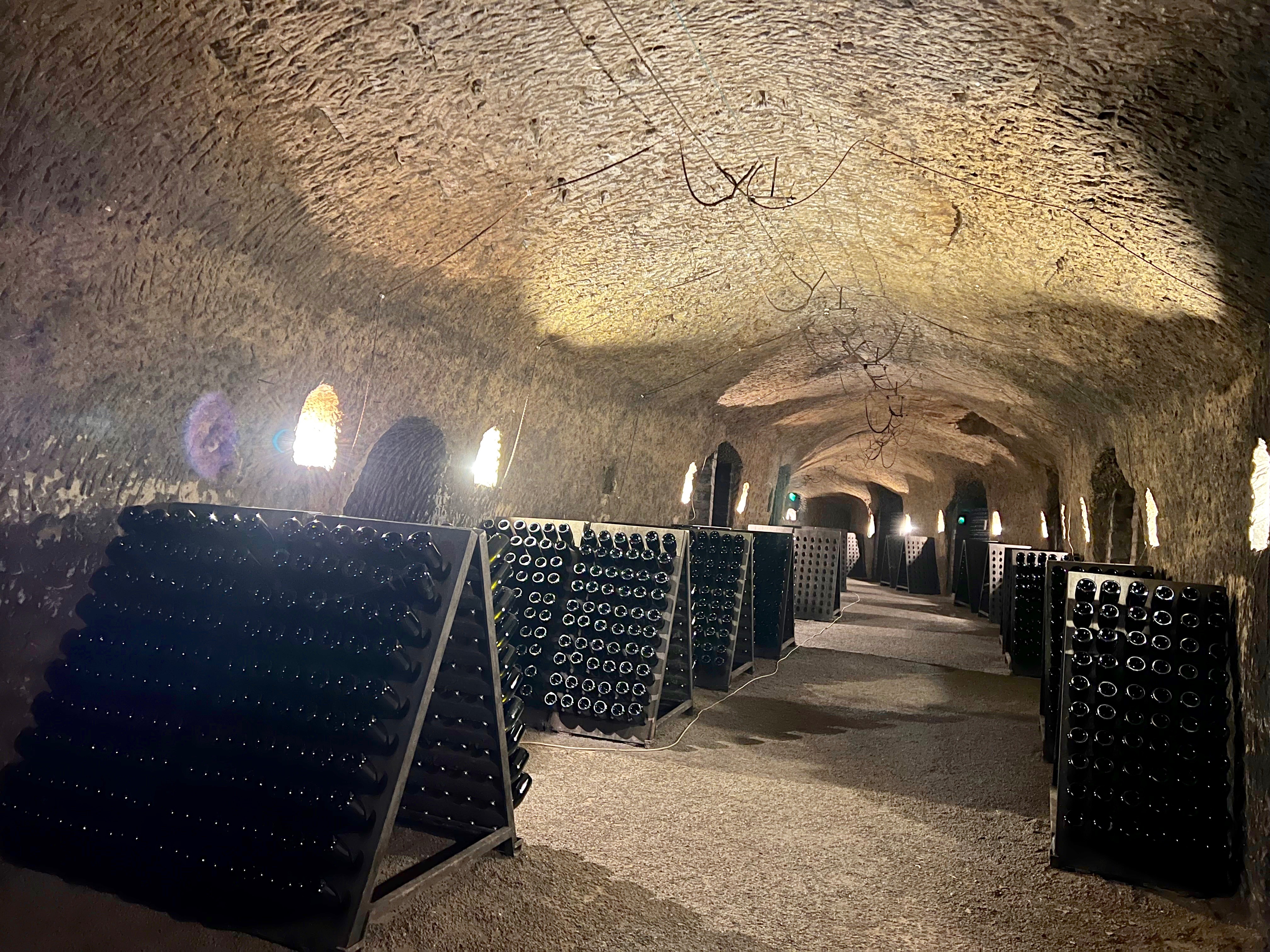
We ended our winery visit at the cellar caves. During the Etruscan era the construction of underground caves also occurred in the countryside beyond Orvieto. The Etruscan era caves on Decugnano Dei Barbi property were dug out by monks in the 13th century. The undergone cellars natural and consistent temperature and humidity create the perfect environment for maturing wine. As we walked through we could view the cellar's wall and feel the humidity. These caves are used to produce the Metodo Classico Brut vintage sparkling wine, made with 50 % Chardonnay and 50 % Pinot Noir.


Decugnano Dei Barbi Underground Cellars © Spaswinefood


Indeed the history of these caves are very unique.


Underground Caves, Decugnano Dei Barbi © Spaswinefood

Sparkling Wines, Decugnano Dei Barbi © Spaswinefood

Seeing the underground caves was the perfect way to end our visit.

Decugnano Dei Barbi Cellars © Spaswinefood


Wine Barrels, Decugnano Dei Barbi © Spaswinefood

Into the Light, Decugnano Dei Barbi © Spaswinefood


We viewed fossils in the walls of the cellar caves. Earlier, as we walked the property we saw shells in the soil however, seeing the fossils in the caves rock wall brought geological history into full view.


Viewing Fossilized Shells, Decugnano Dei Barbi © Spaswinefood

As we walked back to the car we discussed leaf changes in the fall.


Orvieto in the Distance, Decugnano Dei Barbi Vineyard © Spaswinefood

I stopped to get more photos of Orvieto wine country.

Decugnano Dei Barbi Vineyard, Orvieto © Spaswinefood

Going to and from the wine tasting, we passed vineyards and took in those panoramic views of the surrounding countryside. This is an amazing property to tour. 

Later driving back from the winery to Todi we would again enjoy seeing the beautiful October vineyards and countryside.

Orvieto Vineyard © Spaswinefood
Roses in the October Vineyard, Orvieto © Spaswinefood

Orvieto Vineyard in October © Spaswinefood


Decugnano Dei Barbi in Umbria's Orvieto is a must visit. The Magic of Decugnano Dei Barbi is captivating.  Decugnano Dei Barbi runs a variety of tours, tastings, and other experiences such as cooking classes. You can enquire and book online at www.decugnanodeibarbi.com. You will discover that Umbria is a region with a proud history and a long tradition for winemaking. While it does not enjoy the prestige of Tuscany for its wines Umbria produces some of Italy’s most unique and exquisite wines. Umbria can rival anywhere in the country for its natural beauty. While Orvieto is the largest wine producing region within Umbria other top sub-regions include Assisi, and Montefalco. I invite you to join me in our wine travels in Italy and elsewhere at Wine Travels with Dr. Sharon, and at Spaswinefood on Twitter and Facebook. I am so looking forward to sharing future vine-filled explorations in Italy. 


CHEERS!


Sharon 
October 2022
Umbria, Italy 
© Spaswinefood

Decugnano Dei Barbi © Spaswinefood
Orvieto in the Distance, Decugnano Dei Barbi © Spaswinefood

Orvieto in the Distance © Spaswinefood

Always a pleasure to return to Tablas Creek Vineyard, Paso Robles

I am off to Greece and bringing with me some Tablas Creek wines.  Tablas Creek Vineyard,  one of  Paso Robles  premier wineries, was one of ...